
Didenko Capital buys warehouses directly from owners: distribution warehouses, storage warehouses, manufacturing buildings, and small-bay and flex warehouses, in all states. Tell us about your warehouse and get a cash offer.
- ✓ Cash offer
- ✓ Sell as-is — no repairs needed
- ✓ No commission to us
- ✓ No listing
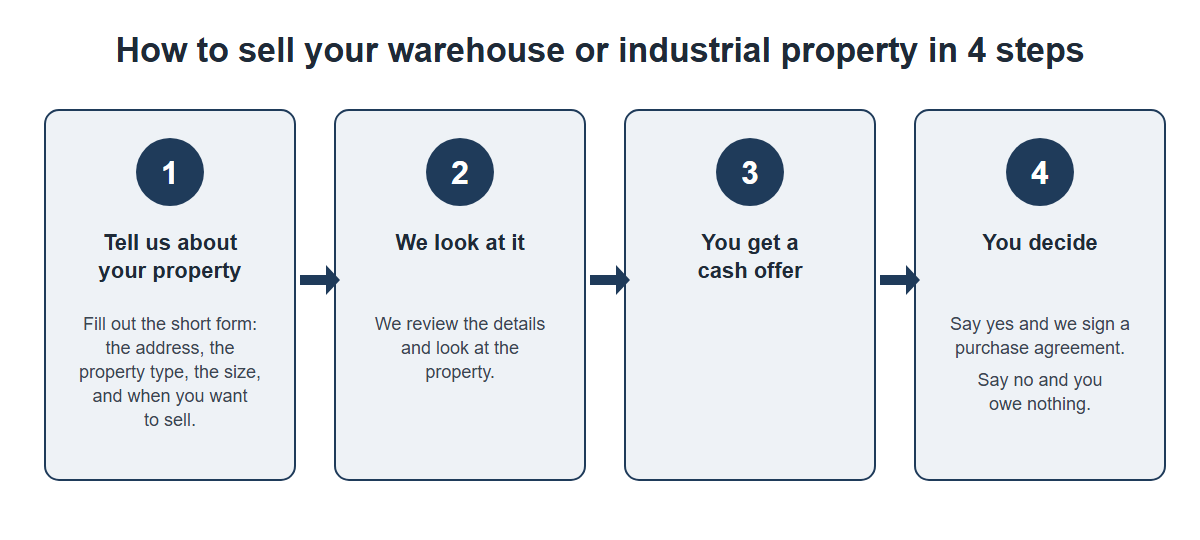
How to Sell Your Warehouse in 4 Steps
- Tell us about your warehouse. Use the short form: address, occupancy, condition, and your timing.
- We look at it. We review the details and look at the warehouse.
- You get a cash offer.
- You decide. Say yes and we sign a purchase agreement. Say no and you owe nothing.
Types of Warehouses
Distribution Warehouses
Buildings with loading docks or drive-in doors, used to store and ship goods.
Storage Warehouses
Warehouses used for storing products, materials, or equipment.
Manufacturing and Production Buildings
Buildings used to make or assemble products.
Small-Bay and Flex Warehouses
Smaller warehouse units and buildings that mix warehouse space with office or showroom space.
Warehouses with Outdoor Storage Yards
Warehouses with extra land for trucks, trailers, containers, or equipment — industrial outdoor storage (IOS).
Vacant, owner-occupied, or leased to tenants. Condition does not rule a property out.
Selling a Vacant, Leased, or Older Warehouse
Vacant Warehouses
An empty warehouse keeps costing taxes, insurance and upkeep while it waits for a buyer. You don’t need to fix, clean out, or improve anything before talking to us.
Warehouses That Need Work
Deferred maintenance, an old roof, needed repairs, environmental questions — none of that rules a property out on its own.
Leased Warehouses
We look at the building or yard, any leases, and the local market. Tell us the situation and we’ll factor it in.
Owner-Occupied Warehouses
Want to stay in the building after you sell? Ask us about a sale-leaseback.
If you’re not sure your property fits, ask — it’s a quick answer.
Selling a Warehouse Directly vs. Listing with a Broker
| List with a broker | Sell directly to Didenko Capital | |
|---|---|---|
| Commission | The seller usually pays the broker a commission | No commission to us |
| Listing | Your warehouse is listed and marketed for sale | No listing |
| Finding a buyer | You wait for a buyer to make an offer | We buy directly — you deal with us, not a broker |
| Repairs | You may fix things up to attract buyers | No repairs needed — we buy as-is |
| Offer | Offers come from whoever the listing attracts | A cash offer from us |
Where We Buy: All States
We buy warehouses in all states, including Pennsylvania and the Philadelphia area. Wherever your warehouse is in the U.S., tell us about it.
We buy in all metro areas, in all states. Pick your state or metro area below to see local zoning, market numbers, and how selling to us works there.
Metro areas and states
Sell My Warehouse: Frequently Asked Questions
Who buys warehouses directly from owners?
Direct buyers such as Didenko Capital. We buy warehouses straight from owners in all states, with a cash offer and no commission to us.
How do I sell my warehouse without a realtor or broker?
Sell it directly to a buyer. Fill out our form, we look at the warehouse, and you get a cash offer. There is no listing agreement and no commission to us. Prefer to sell it yourself? Our guide walks through the steps of a sale by owner and what to watch for.
What types of warehouses do you buy?
Distribution warehouses, storage warehouses, manufacturing buildings, small-bay and flex warehouses, and warehouses with outdoor storage yards.
Is there a size limit?
Send us your warehouse whatever its size. We look at small-bay buildings, single-tenant warehouses, and large distribution buildings.
Do you buy warehouses in my state?
Yes. We buy in all states.
Will you buy my warehouse as-is?
Yes. We buy as-is, so you do not have to make repairs or upgrades first.
Can I sell a warehouse that has tenants?
Yes. We buy buildings that are leased to tenants, owner-occupied, or vacant. Send the leases and the rent roll early, because they are part of the value.
I run my business in the warehouse. Can I still sell it?
Yes. We buy owner-occupied warehouses. Want to stay in the building after you sell? Ask us about a sale-leaseback.
Do you charge a commission or fees?
No. We buy directly — you deal with us, not a broker. There is no commission to us and no fee to us.
How fast can I sell my warehouse?
Selling directly to a buyer is faster than listing, because there is no marketing period and no waiting for a buyer to appear. The exact closing date depends on the property — the title work, any leases, and inspections — and it is written into the purchase agreement.
Is it a cash offer?
Yes. We make cash offers.
How do you decide the price?
We look at what similar industrial properties sell for, the rent the property earns or could earn, its condition, and the cost of any repairs it needs.
When will I get an offer?
After we review the details you send us and look at the property.
What happens after I accept the offer?
We sign a purchase agreement. A title company or closing attorney handles the title search and the closing paperwork. We finish our review of the property. At closing, you sign the deed and get paid.
What documents do I need to sell my commercial property?
To start, only the details on our form. Later: the deed, any leases and the rent roll, recent property tax bills, a survey, and any environmental reports you already have.
Is there any obligation if I ask for an offer?
No. Asking for an offer is free, and you are not committed to anything unless you sign a purchase agreement.
Can you buy a property with environmental issues?
Often, yes. Environmental history is part of how we price a property, not an automatic no.
Can I sell if there are liens or unpaid property taxes?
Usually, yes. Liens and unpaid property taxes are normally paid off from the sale money at closing.
Can I sell if I still have a mortgage on the property?
Yes. The mortgage is usually paid off from the sale money at closing.
Who pays closing costs?
It depends on the property and the deal. The split is written into the purchase agreement, so you see it before you sign.
Why sell my warehouse for cash instead of listing it?
Selling directly is usually the fastest, because there is no listing period. There is no commission to us, and you do not have to fix anything first.
What a Warehouse Buyer Measures
Two warehouses of the same size can sell for very different prices, and the layout can be part of the reason. NAIOP’s terms guide defines the features people compare:
- Clear height. The distance from the floor to the lowest beam, joist or truss across most of the work area. NAIOP calls it the most important measure of interior height.
- Dock-high doors. These usually open about four feet above the truck court, the standard height of a tractor trailer.
- Drive-in doors. Trucks and forklifts can enter without a change in elevation.
- Truck court. The loading and maneuvering area next to the docks. Its depth is what matters most.
- Column spacing. The distance between posts in the warehouse section, which sets the size of each bay.
- Door ratio. The number of docks and drive-in doors compared with the building’s square feet.
Measure these before you talk to anyone. If you do not have the plans, a tape measure and a count of the doors get you most of the way. A fuller walk-through is in how to sell a warehouse, and pricing is covered in what your property is worth.
How Many Warehouses There Are
The U.S. Energy Information Administration’s 2018 survey of commercial buildings estimated about 1,004,000 warehouse and storage buildings, averaging about 17,400 square feet. That group also counts public self-storage.
By business count, the U.S. Census Bureau’s 2023 County Business Patterns shows where warehousing companies cluster. These are warehousing and storage establishments (NAICS 493) in each metro area:
These count operating businesses in the warehousing industry, not buildings for sale.
Selling a Vacant Warehouse: Insurance and City Rules
An empty warehouse has costs a leased one does not. Read the policy and the city rules before the building sits for long:
- Insurance wording. Policies can treat a building as vacant based on how much of it is in use. One policy before a Michigan court in 2026 called a building vacant unless at least 31% of its total square footage was in use. Read your own policy, because wording differs.
- Frozen pipes. In that same case, a pipe feeding the building’s sprinkler burst after freezing. Keep heat and sprinkler protection in place while the building is empty.
- Chicago. The city says a guard or watchman does not make a building occupied, and that unfixed violations can bring significant fines or authority to board up or demolish.
- Philadelphia. The city says you need a Vacant Commercial Property License if a commercial property has been vacant for more than three months.
Check with your own city, because many have their own version. More in selling a vacant warehouse.
Selling a Warehouse With Leases in Place
A lease does not end because the building sold. Cornell’s Legal Information Institute describes a lease as the right to possess and use property for a specified period, with the owner keeping ownership. So the next owner takes the building with the tenant inside. Two terms come up:
- Estoppel. Cornell describes it as a bar on asserting a claim that contradicts what one has said or done before. In a lease setting, a tenant’s estoppel statement confirms the lease terms, so read yours with your attorney.
- The rent roll. List every tenant, lease term, rent amount and any arrears. Reonomy’s guide for owners puts this among the first papers to gather.
More in selling a warehouse with tenants.
Staying in Your Warehouse After the Sale
Owners who run a business in the building sometimes sell it and lease it back. The Journal of Accountancy describes a sale and leaseback as a contract where a seller sells an asset to a buyer and then enters into a second contract to lease it back. It lists an immediate inflow of cash for the business among the benefits.
The IRS adds a caution: IRS Publication 544 says some agreements that seem to be leases may really be conditional sales contracts, and that there is no test or group of tests to prove what the parties intended. Ask your tax advisor before you sign one. See how a sale-leaseback works.
An Inherited Warehouse
If you inherited the building, your tax starting point may be very different from what the last owner paid. IRS Publication 551 says your basis in inherited property is generally the fair market value at the date of the individual’s death, or on the alternate valuation date if the personal representative chooses it. It lists exceptions, so this is one to take to a tax advisor. Publication 559 says to consult local law on who the legal owner is, to work out whether the estate or the beneficiaries report the gain or loss.
Other Pages for Warehouse Owners
Selling more than a warehouse? See selling industrial property, selling an IOS yard and selling commercial property fast. Doing the sale yourself? See selling by owner, the documents to gather and liens or unpaid taxes. Questions are welcome through the contact page, and more guides are on the blog.
Sources
Facts in the sections above come from these public sources, read on the dates shown.
- NAIOP Research Foundation, NAIOP Terms and Definitions: North American Office and Industrial Market, 2012 edition, PDF (read 2026-11-09).
- U.S. Energy Information Administration (EIA), 2018 Commercial Buildings Energy Consumption Survey (CBECS), Table B1, web page (read 2026-11-09).
- U.S. Energy Information Administration (EIA), CBECS building type definitions, web page (read 2026-11-09).
- U.S. Census Bureau, 2023 County Business Patterns, metro area file, NAICS 493 (read 2026-10-22).
- Michigan Court of Appeals, Cherry Hill Recreation Center, Inc. v Conifer Insurance Company, No. 374445, unpublished opinion, PDF (read 2026-11-09).
- City of Chicago, Department of Buildings, Vacant Buildings FAQ, web page (read 2026-11-09).
- City of Philadelphia, Get a Vacant Commercial Property License, web page (read 2026-11-09).
- Cornell Law School, Legal Information Institute, Wex: lease, web page (read 2026-11-09).
- Cornell Law School, Legal Information Institute, Wex: estoppel, web page (read 2026-11-09).
- Reonomy, How to sell commercial real estate: a step-by-step guide for owners and brokers, web page (read 2026-11-09).
- Journal of Accountancy, Accounting for sale and leaseback transactions, web page (read 2026-11-09).
- Internal Revenue Service (IRS), Publication 544, Sales and Other Dispositions of Assets, web page (read 2026-11-09).
- Internal Revenue Service (IRS), Publication 551, Basis of Assets, web page (read 2026-11-09).
- Internal Revenue Service (IRS), Publication 559, Survivors, Executors, and Administrators, web page (read 2026-11-09).
Get a Cash Offer for Your Warehouse
We buy in all states, as-is, with a cash offer and no commission to us. Fill out the short form below to get started.
Related: We buy warehouses and industrial property · Sell commercial property fast · Sell commercial property for cash · How to sell a warehouse · Sell industrial property