
Home › Sell My Warehouse › Los Angeles, CA
Didenko Capital buys warehouses, IOS yards, and light-industrial and flex buildings in the Los Angeles area. We buy warehouses in all states, including California and the Los Angeles area.
- ✓ Cash offer
- ✓ Sell as-is — no repairs needed
- ✓ No commission to us
- ✓ No listing
Selling in Los Angeles comes with local rules. What a Los Angeles seller should know, section by section: the City’s industrial zones, the latest market numbers and submarkets, port, rail and air cargo links, and California’s rules on property tax value, deed paperwork and brownfield cleanup.
Los Angeles Warehouses, IOS Yards, and Flex Buildings
We buy truck yards, trailer yards, container yards, and other industrial outdoor storage (IOS) sites in the Los Angeles area. We buy manufacturing buildings and industrial land in the Los Angeles area.
We buy buildings that are leased to tenants, owner-occupied, or vacant. Condition does not rule a property out. Want to stay in the building after you sell? Ask us about a sale-leaseback.
Manufacturing space in the Los Angeles market asked an average of $1.20 per sq ft per month in Q3 2026 and warehouse/distribution space $1.34, both triple net, in Cushman & Wakefield’s MarketBeat. LA South drew 37.2% of that quarter’s leasing volume, with LA Central next at 23.2%.
Los Angeles Industrial Market Facts
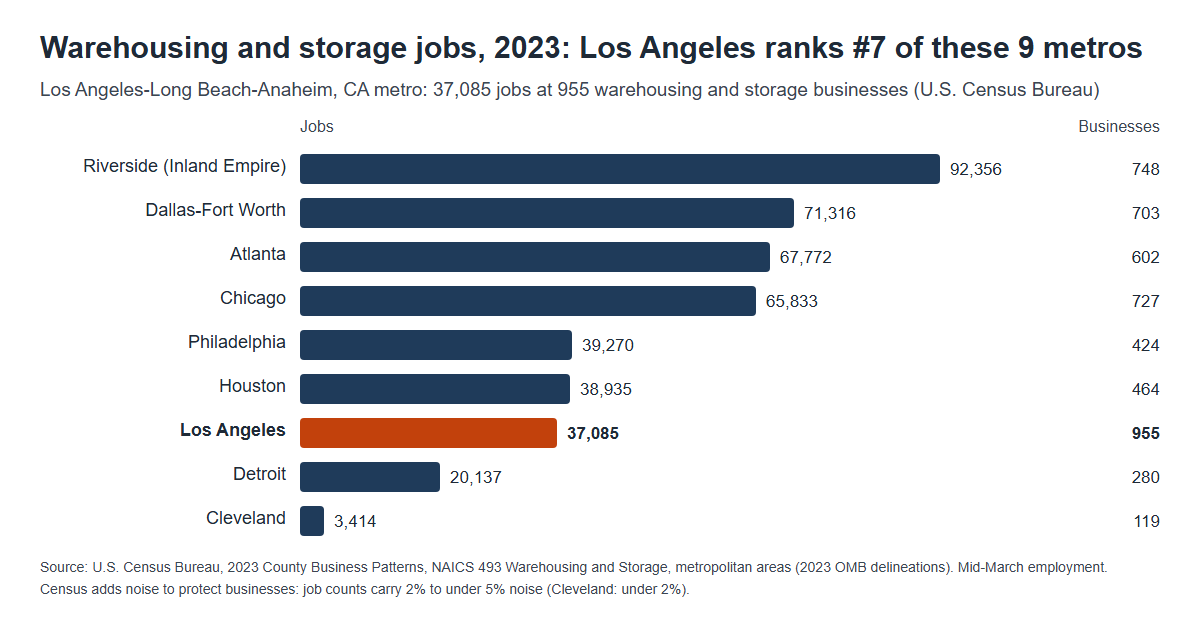
Industrial Zoning in the City of Los Angeles
The City of Los Angeles says Chapter 1 of the Los Angeles Municipal Code, the Original Zoning Code, went into effect on June 1, 1946 and applies to all areas of the city except the Downtown Community Plan. It says Chapter 1A, the New Zoning Code, went into effect in early 2025 and applies to the Downtown Community Plan Area and to later Community Plan Area updates.
The City’s Generalized Summary of Zoning Regulations (updated January 2026) lists five manufacturing zones, from MR1 Restricted Industrial to M3 Heavy Industrial, shown below in the City’s own wording.
| Zone | Name | Uses (the City’s summary, its own wording) |
|---|---|---|
| MR1 | Restricted Industrial | CM Uses, Limited Commercial and Manufacturing, Clinics, Media Products, Limited Machine Shops, Animal Hospitals and Kennels |
| M1 | Limited Industrial | MR1 Uses, Limited Industrial and Manufacturing Uses, no R Zone Uses, no Hospitals, Schools, Churches, any Enclosed C2 Use, Wireless Telecommunications, Household Storage |
| MR2 | Restricted Light Industrial | MR1 Uses, Additional Industrial Uses, Mortuaries, Animal Keeping |
| M2 | Light Industrial | M1 and MR2 Uses, Additional Industrial Uses, Storage Yards, Animal Keeping, Enclosed Composting, no R Zone Uses |
| M3 | Heavy Industrial | M2 Uses, … Nuisance Type Uses 500 ft from any other Zone, no R Zone Uses |
The summary says it is only a guide, and that definitive information should be obtained from Chapter 1 of the Los Angeles Municipal Code itself and from consultation with the Department of City Planning.
- The City says the number after the zone class is the height district, which limits the height of a building and its square footage, and that a Q condition prefix can further limit the types of allowed uses that the zone class would otherwise permit.
- The City says most properties across Los Angeles are subject to some type of overlay, an additional layer of planning control that limits or further restricts what can be built beyond what the zoning allows.
- To look up one property, the City points to ZIMAS, its Zone Information and Map Access System, which can be searched by property address, street intersection or Assessor Parcel Number.
Sources: Los Angeles City Planning, Original Zoning Code (Chapter 1), web page; Los Angeles City Planning, Generalized Summary of Zoning Regulations, Updated January 2026 (CP-7150, PDF); Los Angeles City Planning, Zoning Search (ZIMAS), web page.
Overlays can change what a base district allows, so check your exact property.
A summary, not legal advice: the Zoning Code itself governs.
Los Angeles Industrial Market: Q3 2026
Cushman & Wakefield’s MarketBeat Los Angeles Industrial for Q3 2026 splits the Los Angeles market into six submarkets. Its market-wide figures:
- Inventory: 787,870,594 sq ft.
- Vacancy: 4.3%, up 30 basis points on the quarter but 10 basis points below the year-ago level; the report calls it the first rise since Q4 2024.
- Net absorption: negative 1,473,242 sq ft in the third quarter, the first negative quarter since Q3 2024, but positive 1,828,054 sq ft year to date.
- Leasing: 7.6 million sq ft in Q3 2026, down 36.7% on the quarter and 24.9% on the year; 29.0 million sq ft year to date, the strongest first three quarters since 2021 and 6.5% ahead of the 2025 pace.
- Average asking rent: $1.33 per sq ft a month, triple net, up $0.02 on the quarter and the first increase since Q2 2023, yet $0.02 below a year earlier and $0.38 below the 2023 peak.
- Under construction: 6,484,048 sq ft in 39 buildings, with LA North and LA South holding 79.0% of it.
- Delivered: four buildings totaling 674,332 sq ft in Q3 2026; 1,435,776 sq ft across 11 buildings year to date, 80.3% of it in San Gabriel Valley and LA Central.
These are one firm’s figures for one quarter.
Newer quarters and other reports may differ.
Los Angeles Industrial Submarkets, Largest First
The six submarkets in Q3 2026, biggest inventory first, with vacancy:
| Submarket | Inventory (sq ft) | Vacancy |
|---|---|---|
| LA Central | 198,592,099 | 4.1% |
| LA South | 185,618,556 | 5.1% |
| San Gabriel Valley | 156,465,374 | 3.3% |
| LA North | 149,616,971 | 4.6% |
| Mid-Counties | 89,413,335 | 4.3% |
| LA West | 8,164,259 | 2.1% |
Source: Cushman & Wakefield, MarketBeat Los Angeles Industrial, Q3 2026 (4-page PDF).
Port, Rail and Air Cargo
- Port of Los Angeles: 10.2 million TEUs of containers in calendar year 2025, against 10.3 million TEUs in 2024, in the Port’s own facts and figures.
- The Port says it had a 17% market share in 2025 of the 39.8 million TEUs of international trade that moved in shipping containers through U.S. seaports.
- Alameda Corridor: it runs from the ports of Long Beach and Los Angeles 20 miles north to downtown Los Angeles, primarily along and adjacent to Alameda Street. Its Mid-Corridor Trench carries freight trains in an open trench 10 miles long, 33 feet deep and 50 feet wide, and operations began in April 2002, according to the Alameda Corridor Transportation Authority.
- Los Angeles International (LAX): 7th nationally for all-cargo landed weight in 2025 at 7,798,528,026 lbs, a 6.59% drop from 2024, according to the Federal Aviation Administration’s final calendar year 2025 table.
Sources: Port of Los Angeles, Facts and Figures, web page (CY 2025 column); Alameda Corridor Transportation Authority, About, web page; Federal Aviation Administration, Final Calendar Year 2025 All-Cargo Landed Weight, LAX row, table dated 9/22/2026.
How It Works
- Tell us about your property. Fill out the short form: the address, the condition, and when you want to sell.
- We look at it. We review the details and look at the property.
- You get a cash offer.
- You decide. Say yes and we sign a purchase agreement. Say no and you owe nothing.
There is no commission to us and no fee to us. Asking for an offer is free, and you are not committed to anything unless you sign a purchase agreement.
Selling a Warehouse in Los Angeles: Frequently Asked Questions
Who buys warehouses directly from owners in Los Angeles?
Direct buyers such as Didenko Capital. Didenko Capital is run by Yarik Didenko. We buy warehouses in all states, including California and the Los Angeles area.
Is an outdoor storage (IOS) yard allowed on a Los Angeles industrial lot?
It depends on the zoning district. In the City of Los Angeles, the City’s zoning summary lists Storage Yards among the uses of the M2 Light Industrial zone, and the M3 Heavy Industrial zone takes in M2 Uses. City Planning’s use list shows open storage, truck or bus parking and trucking yards or terminals in all five zones, utility trailer storage and truck storage yards in M1, M2 and M3, and cargo container storage yards, marked “(restrictions)”, in M2 and M3 only. In MR1 those yards need a completely enclosed building or an area with a solid wall or fence at least six feet high on all sides, with nothing stored above it; M1 and MR2 take in MR1 uses under the same limits, and M1’s trailer and truck storage yards also need a building or a 6-foot solid wall or fence. M2 takes in M1 and MR2 uses with no building or enclosed area required unless the list says one is needed. In M2 and M3 the cargo container storage yard sits among the conditional and public benefit uses, and the City’s 2022 update says restrictions must be met for it to be allowed by right. Ask your attorney before counting on a use.
How do I check a property’s zoning in the City of Los Angeles?
Search the address or Assessor Parcel Number in ZIMAS, the City’s Zone Information and Map Access System; the City says the zoning is under the “Planning and Zoning Menu.” The City also says ZIMAS lists whether a site is within a Historic Overlay Preservation Zone, a Specific Plan or a Community Design Overlay.
What happens to the property tax value when a California industrial property is sold?
The California State Board of Equalization says that once the county assessor has determined that a change in ownership has occurred, Proposition 13 requires the county assessor to reassess the property to its current fair market value as of the date ownership changed. It adds that only that portion of the property that changes ownership is subject to reappraisal.
What form goes with the deed when a California property changes hands?
The Board of Equalization says deeds and certain other recorded documents must be accompanied by a Preliminary Change of Ownership Report (PCOR) at the time of the recording, and that the county recorder may charge a $20 fee for filing the PCOR without the accompanying documents.
Can I appeal my industrial property’s assessed value in California?
The Board of Equalization says a taxpayer who disagrees with the value should discuss it with the Assessor’s staff in the county where the property is located, and that if an agreement cannot be reached, taxpayers have a right to appeal the value under certain circumstances and limitations.
What about environmental history on an older Los Angeles site?
Environmental history is part of how we price a property, not an automatic no. California’s State Water Resources Control Board describes brownfields as underutilized properties where reuse is hindered by the actual or suspected presence of pollution. Under a Brownfield Memorandum of Agreement between the Department of Toxic Substances Control (DTSC), the State Water Board and the Regional Water Quality Control Boards, oversight of a brownfields site is limited to one agency. Ask an environmental attorney or consultant about your site.
Do you buy warehouses in California?
Yes. We buy in all states.
Get a Cash Offer for Your Los Angeles Warehouse
We buy in all states, as-is, with a cash offer and no commission to us. Tell us about your warehouse and get a cash offer.
Related: Sell my warehouse · Sell commercial property for cash · Sell commercial property fast · Sell an IOS yard · Sell industrial property · Sell Your Warehouse in Riverside, CA · Sell Your Warehouse in Chicago, IL · Sale-leaseback for warehouse owners · How to sell commercial property by owner · Sell Your Warehouse in Houston, TX · Sell Your Warehouse in Dallas, TX · How much is my commercial property worth · Sell Your Warehouse in Atlanta, GA · Sell Your Warehouse in Philadelphia, PA · Sell Your Warehouse in Cleveland, OH · Sell Your Warehouse in Detroit, MI · Sell Your Warehouse in Lehigh Valley, PA
Sources
Facts on this page come from the public sources listed at the bottom, read on the dates shown.
- Cushman & Wakefield, MarketBeat Los Angeles Industrial, Q3 2026 (4-page PDF) (read 2026-10-21).
- Los Angeles City Planning, Original Zoning Code (Chapter 1), web page (read 2026-10-13).
- Los Angeles City Planning, Generalized Summary of Zoning Regulations, Updated January 2026 (CP-7150, PDF) (read 2026-10-13).
- Los Angeles City Planning, Zoning Search (ZIMAS), web page (read 2026-10-13).
- Port of Los Angeles, Facts and Figures, web page (CY 2025 column) (read 2026-10-13).
- Alameda Corridor Transportation Authority, About, web page (read 2026-10-13).
- Federal Aviation Administration, Final Calendar Year 2025 All-Cargo Landed Weight, LAX row, table dated 9/22/2026 (read 2026-10-13).
- California State Board of Equalization, Change in Ownership – Frequently Asked Questions, web page (read 2026-10-13).
- California State Board of Equalization, Assessment Appeals, web page (read 2026-10-13).
- California State Water Resources Control Board, Brownfields, web page (page last updated 10/20/26) (read 2026-10-21).
- Los Angeles City Planning, List of Uses Permitted in Various Zones in the City of Los Angeles (Use List), Updated 12/20/2022, with the 2022 Use List update summary (PDF linked from the City’s zoning regulations summary page) (read 2026-10-21).