
Home › Sell My Warehouse › Atlanta, GA
Didenko Capital buys warehouses, IOS yards, and light-industrial and flex buildings in the Atlanta area. We buy warehouses in all states, including Georgia and the Atlanta area.
- ✓ Cash offer
- ✓ Sell as-is — no repairs needed
- ✓ No commission to us
- ✓ No listing
Selling in Atlanta comes with local rules. This guide to selling in Atlanta covers the City’s industrial districts, the metro’s submarkets and market numbers, air cargo, and the Georgia rules on tax appeals, deed recording and brownfields.
Atlanta Warehouses, IOS Yards, and Flex Buildings
We buy truck yards, trailer yards, container yards, and other industrial outdoor storage (IOS) sites in the Atlanta area. We buy manufacturing buildings and industrial land in the Atlanta area.
We buy buildings that are leased to tenants, owner-occupied, or vacant. Condition does not rule a property out. Want to stay in the building after you sell? Ask us about a sale-leaseback.
Cushman & Wakefield’s Q3 2026 report on the Atlanta industrial market gives weighted average net asking rents per sq ft per year by building type: $7.71 for warehouse/distribution space, $8.83 for manufacturing space and $13.17 for office service/flex space. The same report counts seven Q3 leases above 500,000 sq ft, three of them over 1.0 million sq ft; together they made up 44.3% of new leasing volume but only 5.4% of the leases signed.
Atlanta Industrial Market Facts
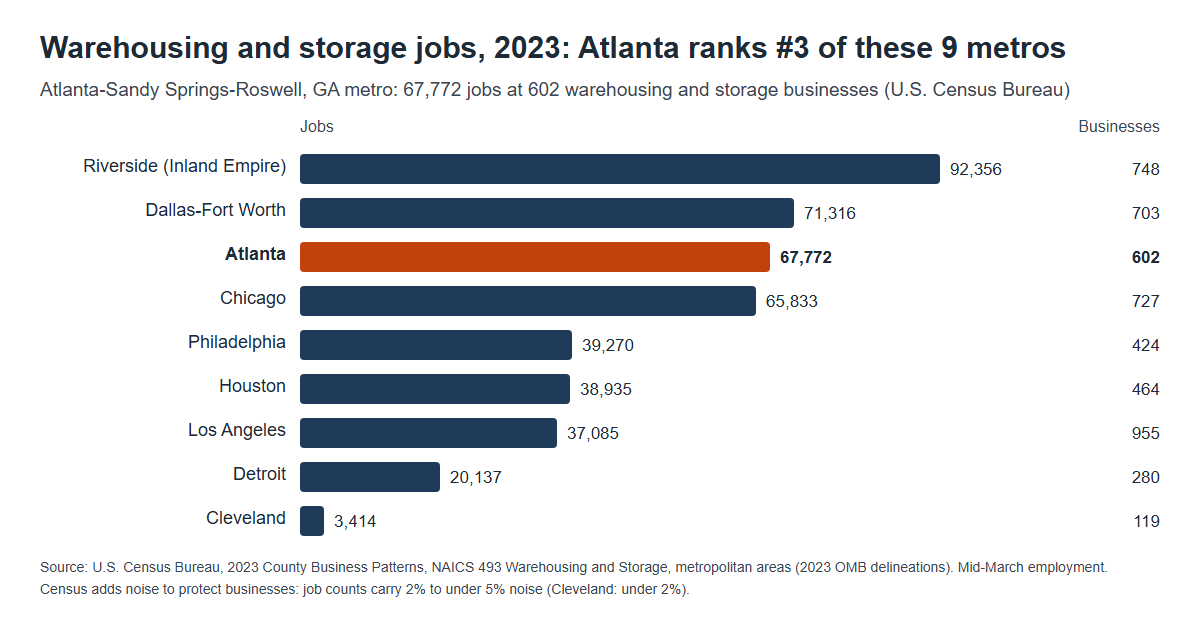
Industrial Zoning in the City of Atlanta
The City of Atlanta’s zoning code, Part 16 of its Code of Ordinances (published online by Municode), sets out an I-1 Light Industrial District and an I-2 Heavy Industrial District. In the code’s statement of intent, I-1 is meant to provide locations for warehousing, storage, light manufacturing, processing, repair services and sales lots, among other uses. I-2 is meant to permit heavy manufacturing in addition to the uses permitted in I-1 districts.
The code says both districts are to be created, expanded or extended only where there is adequate and direct access to major transportation facilities and minimal conflict with residential districts.
| District | Warehousing and distribution centers | Storage yards | Freight or truck terminals |
|---|---|---|---|
| I-1 Light Industrial | Permitted principal uses; the same code item also lists self-storage facilities and carries an exception for property within 500 feet of the beltline corridor | Yards for storage of contractor’s equipment, sand and gravel, lumber and the like are permitted; junkyards, salvage yards and scrap metal processors are excluded | Special use permit, when erected or operated by other than a governmental agency |
| I-2 Heavy Industrial | Permitted principal uses; the same code item also lists self-storage facilities and carries an exception for property within 500 feet of the beltline corridor | Yards for storage of contractor’s equipment, sand and gravel, lumber and similar operations are permitted | Special use permit, when erected or operated other than by a governmental agency |
- The I-1 chapter also permits the conversion of industrial buildings which are 50 years of age or older to multi-family dwellings.
- A third district, the Industrial Mixed Use District (I-MIX), is meant to permit a mix of industrial and non-industrial uses in areas previously used for industrial and certain other purposes. The code lets property be rezoned to it only from a short list of districts that includes I-1 and I-2.
- The City’s planning GIS site offers a Property Information map that looks up zoning and parcel information for one property.
Sources: City of Atlanta, Code of Ordinances (Municode), Part 16 Zoning, Chapter 16: I-1 Light Industrial District Regulations, online code, Supplement 107; City of Atlanta, Code of Ordinances (Municode), Part 16 Zoning, Chapter 17: I-2 Heavy Industrial District Regulations, online code, Supplement 107; City of Atlanta, Code of Ordinances (Municode), Part 16 Zoning, Chapter 16A: Industrial Mixed Use District (I-MIX) Regulations, online code, Supplement 107; City of Atlanta, Department of City Planning GIS, Interactive Maps, web page.
A summary, not legal advice: the Zoning Code itself governs.
Overlays can change what a base district allows, so check your exact property.
Atlanta Industrial Market: Q3 2026
Cushman & Wakefield’s MarketBeat Atlanta Industrial report for Q3 2026 lists these metro figures:
- Inventory: 786,669,352 sq ft.
- Vacancy: 8.6% overall in the report’s table. Its text puts the direct rate, which leaves out subleases, at 7.8%, unchanged from the prior quarter and 80 basis points below Q3 2025.
- Net absorption: 1,842,521 sq ft in the third quarter, the fifth positive quarter in a row, and 8,393,833 sq ft year to date, which the report says already tops the full-year total for 2025.
- New leasing: 13.5 million sq ft in the quarter, the most since 2022 and 22.5% above Q2. The report ranks Atlanta fourth nationally for new leasing and one of only four markets past 10.0 million sq ft in Q3.
- Direct asking rent: $7.79 per sq ft, a new high and 3.0% above Q2.
- Under construction: 8,404,600 sq ft, the most since 2024; nearly half of it (49.2%) is in buildings larger than 500,000 sq ft.
- Deliveries: 2.8 million sq ft in the quarter, against an average of nearly 6.0 million sq ft a quarter from 2021 to 2025. All 11 buildings delivered in the quarter were built speculatively, with 20.2% of their space preleased before completion.
These are one firm’s figures for one quarter.
Newer quarters and other reports may differ.
The Largest Atlanta Industrial Submarkets
The six largest submarkets by inventory in that report’s table are:
| Submarket | Inventory (sq ft) | Overall vacancy |
|---|---|---|
| I-85 North Corridor | 202,228,631 | 7.8% |
| I-75 North Corridor | 118,905,090 | 6.8% |
| I-20 West/Fulton Industrial | 106,162,326 | 7.9% |
| I-75 South/Henry County | 85,522,486 | 15.2% |
| Airport/South Atlanta | 81,425,462 | 11.4% |
| I-85 South/Peachtree City | 74,740,130 | 7.8% |
The report says the quarter’s new supply went mainly to I-75 South and I-85 North, while asking-rent growth was concentrated in I-75 North (8.5%) and I-75 South (8.4%).
Source: Cushman & Wakefield, MarketBeat Atlanta Industrial, Q3 2026 (4-page PDF).
Air Cargo
- Hartsfield/Jackson Atlanta International: its 2,864,017,498 lbs of all-cargo landed weight in calendar year 2025 was 1.98% lower than in 2024 and ranked 15th in the Federal Aviation Administration’s final table.
Source: Federal Aviation Administration, Final Calendar Year 2025 All-Cargo Landed Weight, ATL row, table dated 9/22/2026.
How It Works
- Tell us about your property. Fill out the short form: the address, the property type, the size, and when you want to sell.
- We look at it. We review the details and look at the property.
- You get a cash offer.
- You decide. Say yes and we sign a purchase agreement. Say no and you owe nothing.
There is no commission to us and no fee to us. Asking for an offer is free, and you are not committed to anything unless you sign a purchase agreement.
Selling a Warehouse in Atlanta: Frequently Asked Questions
Who buys warehouses directly from owners in Atlanta?
Direct buyers such as Didenko Capital. Didenko Capital buys warehouses, IOS yards, and light-industrial and flex buildings in the Atlanta area. Didenko Capital is run by Yarik Didenko.
Where in Atlanta can a lot be used as an outdoor storage (IOS) yard?
It depends on the zoning district. In the City of Atlanta, the zoning code lists yards for storage of contractor’s equipment, sand and gravel, and lumber among the permitted principal uses in both the I-1 and I-2 districts; the I-1 listing specifically excludes junkyards, salvage yards and scrap metal processors. Freight and truck terminals not erected or operated by a governmental agency need a special use permit in both districts. The I-1 and I-2 chapters have no separate listing for truck or trailer parking or for container yards; both list parking surface and structures as a permitted principal use, a listing that does not mention trucks or trailers. Ask your attorney before counting on a use.
How do I look up the zoning of an Atlanta property?
The City’s planning GIS site has a Property Information map that looks up zoning and parcel information for a property, and a Zoning Map Search that searches the Official Zoning Maps by address, parcel ID, owner name or land lot.
How do I appeal a property tax assessment in Georgia?
The Georgia Department of Revenue says the county board of tax assessors must send an annual assessment notice, and an owner who wants to appeal may do so within 45 days of the date the notice was mailed. The written appeal is filed with the County Board of Tax Assessors, not with the Department of Revenue. The owner picks one of three routes: the County Board of Equalization, a Hearing Officer, or an Arbitrator. The Hearing Officer route covers the value or uniformity of value of non-homestead real property, but only when the value is greater than $500,000. The Department says an owner still dissatisfied can then appeal to Superior Court.
What has to happen before a deed is recorded in Georgia?
The Georgia Department of Revenue says the real estate transfer tax must be paid before a deed can be recorded in the office of the clerk of the superior court. It says the PT-61 Real Estate Transfer Tax Declaration can be filed on-line through the Georgia Superior Court Clerks Cooperative Authority (GSCCCA), and that questions about taxability and exemptions go to the Clerk of Superior Court in the county.
What about environmental history on an older Georgia site?
Environmental history is part of how we price a property, not an automatic no. Georgia’s Environmental Protection Division (EPD) says the Georgia Brownfield Act provides liability protection to prospective purchasers of contaminated properties from third party claims arising from past releases and groundwater cleanup. In exchange, they must investigate and clean up soil and source material to meet the state’s risk reduction standards. EPD says its final limitation of liability certificates serve as “ready for reuse” determinations. Ask an environmental attorney or consultant about your site.
Is there any obligation if I ask for an offer?
No. Asking for an offer is free, and you are not committed to anything unless you sign a purchase agreement.
Do you buy warehouses in Georgia?
Yes. We buy in all states.
Get a Cash Offer for Your Atlanta Warehouse
We buy in all states, as-is, with a cash offer and no commission to us. Tell us about your warehouse and get a cash offer.
Related: Sell my warehouse · Sell Your Warehouse in Houston, TX · Sell Your Warehouse in Cleveland, OH · How to sell commercial property by owner · Sell Your Warehouse in Detroit, MI · Sell Your Warehouse in Chicago, IL · Sell Your Warehouse in Philadelphia, PA · Sale-leaseback for warehouse owners · How much is my commercial property worth
Sources
Facts on this page come from the public sources listed at the bottom, read on the dates shown.
- Cushman & Wakefield, MarketBeat Atlanta Industrial, Q3 2026 (4-page PDF) (read 2026-10-21).
- City of Atlanta, Code of Ordinances (Municode), Part 16 Zoning, Chapter 16: I-1 Light Industrial District Regulations, online code, Supplement 107 (read 2026-10-21).
- City of Atlanta, Code of Ordinances (Municode), Part 16 Zoning, Chapter 17: I-2 Heavy Industrial District Regulations, online code, Supplement 107 (read 2026-10-21).
- City of Atlanta, Code of Ordinances (Municode), Part 16 Zoning, Chapter 16A: Industrial Mixed Use District (I-MIX) Regulations, online code, Supplement 107 (read 2026-10-13).
- City of Atlanta, Department of City Planning GIS, Interactive Maps, web page (read 2026-10-13).
- Georgia Department of Revenue, Filing a Property Tax Appeal, web page (read 2026-10-13).
- Georgia Department of Revenue, Real Estate Transfer Tax, web page (read 2026-10-13).
- Georgia Environmental Protection Division (EPD), Land Protection Branch, Brownfield, web page (read 2026-10-13).
- Federal Aviation Administration, Final Calendar Year 2025 All-Cargo Landed Weight, ATL row, table dated 9/22/2026 (read 2026-10-13).