
Home › Sell My Warehouse › Detroit, MI
Didenko Capital buys warehouses, IOS yards, and light-industrial and flex buildings in the Detroit area. We buy warehouses in all states, including Michigan and the Detroit area.
- ✓ Cash offer
- ✓ Sell as-is — no repairs needed
- ✓ No commission to us
- ✓ No listing
Selling in Detroit comes with local rules. Within this page: Detroit’s industrial districts and what each allows, market numbers by submarket, port, air cargo and border bridge links, property tax appeals, and what Michigan’s environment department says about baseline environmental assessments and brownfields.
Detroit Warehouses, IOS Yards, and Flex Buildings
We buy truck yards, trailer yards, container yards, and other industrial outdoor storage (IOS) sites in the Detroit area. We buy manufacturing buildings and industrial land in the Detroit area.
We buy buildings that are leased to tenants, owner-occupied, or vacant. Condition does not rule a property out. Want to stay in the building after you sell? Ask us about a sale-leaseback.
In Cushman & Wakefield’s Q3 2026 Detroit report, the overall weighted average net asking rent is $6.48 per sq ft for warehouse/distribution space, $7.86 for manufacturing and $11.40 for office service/flex.
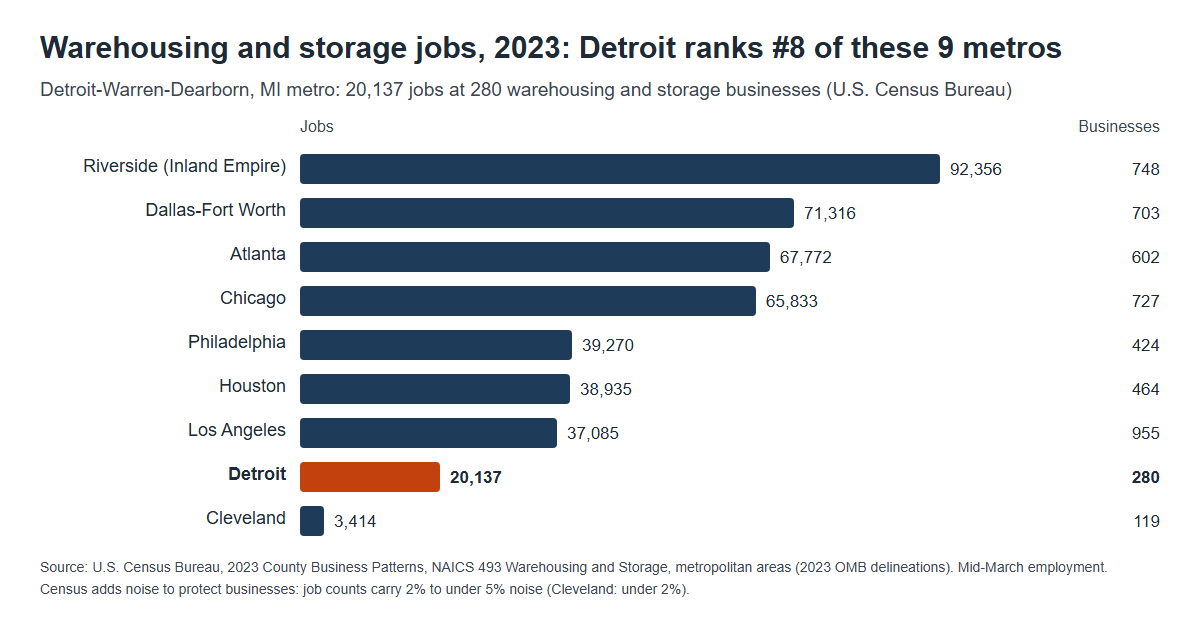
Detroit Industrial Market Facts
Industrial Zoning in the City of Detroit
Within the city limits, zoning is set by Chapter 50 of the Detroit City Code, the Zoning Ordinance. Its Article X covers five industrial districts, M1 through M5, and gives each one a general purpose statement and a list of permitted uses. In the code’s own words, shortened, by district:
- M1 Limited Industrial: used primarily along major and secondary thoroughfares in blocks which contain older, vacant structures, mixed land uses, or other deficiencies, and where the Master Plan indicates industrial development to be the desirable ultimate use; its purpose is to permit these vacant structures to be used for necessary economic activities.
- M2 Restricted Industrial: designed for a wide range of industrial and related uses which can function with a minimum of undesirable effects; industrial establishments of this type provide a buffer between residential districts and intensive industrial districts.
- M3 General Industrial: property suitable for industrial development, but where the modes of operation of the industry may affect any nearby residential uses; its purpose is to permit the normal operation of a majority of industries, subject only to those regulations needed to control congestion and to protect nearby residential districts.
- M4 Intensive Industrial: permits uses which are usually objectionable, so the district is rarely, if ever, located adjacent to residential districts.
- M5 Special Industrial: composed primarily of property located deep within other industrial districts; it indicates areas of the City which are best suited for development with intensive uses and are or can be objectionable or hazardous.
How the code treats four uses:
| District | Warehousing and storage buildings | Outdoor storage yard | Trucking terminal and semi-trailer parking area | Containerized freight yard |
|---|---|---|---|---|
| M1 Limited Industrial | By right | Not allowed (blank in the use table) | Conditional | Not allowed (blank in the use table) |
| M2 Restricted Industrial | By right | Not allowed (blank in the use table) | By right | Conditional |
| M3 General Industrial | By right | Conditional | By right | By right |
| M4 Intensive Industrial | By right | By right | By right | By right |
| M5 Special Industrial | By right | By right | By right | By right |
The use tables in Article XII of Chapter 50 summarize the principal use regulations of the districts. In those tables, an “R” means a use is allowed as a matter-of-right in the district and is subject to compliance with all other applicable regulations of Chapter 50; a “C” means it is allowed only where reviewed and approved under the conditional use permit procedures of Article III, Division 7; and a blank cell means a use type is not allowed in the district, unless it is otherwise expressly allowed by other regulations in Chapter 50. The outdoor storage yard row (Section 50-12-81) is blank for M1 and M2. The containerized freight yard row (Section 50-12-83) is blank for M1. The trucking column is one code item: “Trucking terminal, transfer building, recreational vehicle storage lot, and open area for the parking of semi-trailers, buses, and other operable commercial vehicles,” not including limousines and taxicabs. The City’s Buildings, Safety Engineering and Environmental Department (BSEED) says Special Land Use Hearings are required for uses that are “conditional” in the specific zoning district, and Article X requires site plan review for all conditional uses and for certain by-right uses in each industrial district.
To check one parcel, BSEED points to its Zoning Portal to identify a use type and zoning district, and to its Zoning Verification Letters, which identify the zoning district(s), legal uses and permissions for a specific use at specific parcel(s).
Sources: City of Detroit, Code of Ordinances (Municode), Detroit City Code, Chapter 50 Zoning, Article X Industrial Zoning Districts, online code, Supplement 4 (banner text in Municode’s record for that supplement: codified through Ordinance No. 2024-17, effective March 26, 2024, as well as Ordinance No. 2024-32, effective June 25, 2024); City of Detroit, Code of Ordinances (Municode), Detroit City Code, Chapter 50 Zoning, Article XII Use Regulations, online code, Supplement 4 (banner text in Municode’s record for that supplement: codified through Ordinance No. 2024-17, effective March 26, 2024, as well as Ordinance No. 2024-32, effective June 25, 2024); City of Detroit, Buildings, Safety Engineering and Environmental Department (BSEED), Zoning / Special Land Use, web page (no date printed; it lists Special Land Use hearings for October 14 and 15 with 2026 case numbers).
A summary, not legal advice: the Zoning Code itself governs.
Overlays can change what a base district allows, so check your exact property.
Detroit Industrial Market: Q3 2026
Cushman & Wakefield’s MarketBeat Detroit Industrial for Q3 2026 reports:
- Inventory: 506,165,145 sq ft.
- Vacancy: 3.8%, up 30 basis points from a year earlier.
- Net absorption: positive 1,983,387 sq ft in the third quarter, which the report says ended a run of four negative quarters; 485,121 sq ft year to date.
- New leasing: 6.6 million sq ft year to date, up 36.0% from a year earlier, led by big-box demand: eight new deals of 250,000 sq ft or more, against three a year earlier.
- Asking rent: an overall net average of $7.40 per sq ft, up 2.5% from a year earlier.
- Construction: 1,399,367 sq ft delivered year to date and 3,178,377 sq ft under construction; build-to-suit projects made up 69.0% of those deliveries and speculative projects 72.0% of the space being built.
These are one firm’s figures for one quarter.
Newer quarters and other reports may differ.
Detroit Industrial Submarkets
The report’s statistics table divides the market into eleven submarkets, shown here by inventory:
| Submarket | Inventory (sq ft) | Overall vacancy |
|---|---|---|
| Western Wayne | 106,552,707 | 2.7% |
| Detroit (submarket) | 79,863,725 | 5.2% |
| Dearborn/Downriver | 48,625,723 | 3.2% |
| Macomb South | 47,591,644 | 2.0% |
| Oakland Southeast | 44,426,344 | 4.9% |
| Oakland Southwest | 41,880,694 | 5.5% |
| Oakland North | 38,309,106 | 4.9% |
| Macomb Central | 38,148,448 | 1.7% |
| Washtenaw | 27,450,082 | 5.6% |
| Macomb North | 20,952,190 | 5.6% |
| Livingston | 12,364,482 | 1.4% |
Western Wayne held 1,979,028 sq ft of the 3,178,377 sq ft under construction, and the report says move-ins there largely drove the quarter’s occupancy gains: 1,383,445 sq ft of net absorption in that submarket.
Source: Cushman & Wakefield, MarketBeat Detroit Industrial, Q3 2026 (3-page PDF).
Port, Air Cargo and the Gordie Howe International Bridge
- Port of Detroit: the Detroit/Wayne County Port Authority’s 2025 annual report says the port contains 18 terminals in Detroit, River Rouge, and Ecorse. Across both Port Detroit freight terminals, 47 vessels offloaded a combined 359,202.89 net tons of steel and cement as of November 30, 2025, against 415,958 net tons from 58 ships in 2024.
- Detroit Metro Wayne County (DTW): all-cargo landed weight fell 15.34% in calendar year 2025, from 630,502,181 lbs to 533,760,777 lbs; the Federal Aviation Administration’s final table ranks it 48th.
- Gordie Howe International Bridge: a Windsor-Detroit Bridge Authority release dated July 24, 2026 said the bridge would officially open to traffic on Monday, July 27, 2026, as a direct, highway-to-highway connection between Ontario’s Highway 401 and Michigan’s Interstate-75, designed with six bridge lanes, 16 toll lanes and 60 Canada and U.S. inspection lanes. The release calls it the first new crossing between Ontario and Michigan in over 60 years, on a corridor with $300 billion a year in trade between Michigan and Ontario. In a statement dated July 27, 2026, the Authority said it had welcomed the first travellers to the bridge.
Sources: Detroit/Wayne County Port Authority, Annual Report 2025, PDF (uploaded January 2026, per its URL path); Federal Aviation Administration, Final Calendar Year 2025 All-Cargo Landed Weight, DTW row, table dated 9/22/2026; Windsor-Detroit Bridge Authority (Gordie Howe International Bridge), Celebrating the Gordie Howe International Bridge, news release dated July 24, 2026; Windsor-Detroit Bridge Authority (Gordie Howe International Bridge), Statement by the Interim Chief Executive Officer and Chief Legal Officer, statement dated July 27, 2026.
How It Works
- Tell us about your property. Fill out the short form: the address, the property type, the size, and when you want to sell.
- We look at it. We review the details and look at the property.
- You get a cash offer.
- You decide. Say yes and we sign a purchase agreement. Say no and you owe nothing.
There is no commission to us and no fee to us. Asking for an offer is free, and you are not committed to anything unless you sign a purchase agreement.
Selling a Warehouse in Detroit: Frequently Asked Questions
Who buys warehouses directly from owners in Detroit?
Direct buyers such as Didenko Capital. We buy warehouses in all states, including Michigan and the Detroit area. Didenko Capital is run by Yarik Didenko.
Which Detroit districts allow outdoor storage, truck parking or a container yard?
It depends on the zoning district. In the City of Detroit’s zoning code, an outdoor storage yard is a by-right use in the M4 Intensive Industrial and M5 Special Industrial districts and a conditional use in the M3 General Industrial District, and BSEED says Special Land Use Hearings are required for uses that are “conditional” in the specific zoning district. By right is still subject to compliance with all other applicable regulations of Chapter 50: for example, where an outdoor storage yard is the principal use of the land, Section 50-12-344 says no storage yard shall be located less than 150 feet from land zoned R1 through R6 or residential PD, and calls for an opaque fence that is not less than six feet high. In the code’s use table, the outdoor storage yard cells for the M1 and M2 districts are blank, and a blank cell means a use type is not allowed in the district, unless it is otherwise expressly allowed by other regulations in Chapter 50. Truck, trailer and container yards are separate items in the code. The trucking terminal and semi-trailer parking item is a by-right use in M2 through M5 and a conditional use in M1 (Sections 50-10-23, 50-10-47, 50-10-77, 50-10-107 and 50-10-137). A containerized freight yard is a by-right use in M3, M4 and M5 and a conditional use in M2 (Sections 50-10-53, 50-10-77, 50-10-107 and 50-10-137); on land zoned M2, it may not be located less than 150 feet from land zoned R1 through R6 or residential PD. Ask your attorney before counting on a use.
How do I check the zoning of a Detroit property?
The City’s Buildings, Safety Engineering and Environmental Department (BSEED) points to its Zoning Portal to identify a use type and zoning district. For a written answer, BSEED issues Zoning Verification Letters, which identify the zoning district(s), legal uses and permissions for a specific use at specific parcel(s). The ordinance itself is Chapter 50 of the Detroit City Code. BSEED and Chapter 50 cover property within the Detroit city limits. Overlays can change what a base district allows, so check your exact property.
How do property tax appeals work for industrial property in Detroit?
On its page for appeals of the 2026 assessed value, the City of Detroit lists three steps: Assessors Review (local), marked optional; the March Board of Review (local), marked required; and the Michigan Tax Tribunal (state). For the 2026 assessed value, the same page said property classified Commercial Real, Industrial Real or Developmental Real could be appealed to the regular March Board of Review or to the Michigan Tax Tribunal by filing a petition by May 31; it prints no year next to that date. For 2026, the February Assessors Review Period ran from February 1, 2026 through February 22, 2026, and the Board of Review page said appeals to the March Board of Review had to be filed by 4:30 p.m. on Monday, March 9, 2026. The City of Detroit’s Assessor and Board of Review handle property within the city limits. Ask your attorney what that means for your building.
What about environmental history on an older Detroit site?
Environmental history is part of how we price a property, not an automatic no. Michigan’s Department of Environment, Great Lakes, and Energy (EGLE) says a person can buy, lease, or foreclose on contaminated property and be protected from liability for cleanup of existing contamination on the property if they conduct a baseline environmental assessment (BEA) and disclose it to EGLE and subsequent purchasers and transferees, as outlined in Part 201 (Environmental Remediation) and Part 213 (Leaking Underground Storage Tanks). EGLE’s Brownfield Program also provides grants and low-interest loans to communities, year-round, to facilitate the redevelopment of contaminated properties. Ask an environmental attorney or consultant about your site.
Is it a cash offer?
Yes. We make cash offers.
Do you buy warehouses in Michigan?
Yes. We buy in all states.
Get a Cash Offer for Your Detroit Warehouse
We buy in all states, as-is, with a cash offer and no commission to us. Tell us about your warehouse and get a cash offer.
Related: Sell my warehouse · Sell Your Warehouse in Dallas, TX · Sell Your Warehouse in Atlanta, GA · Sell Your Warehouse in Cleveland, OH · How to sell commercial property by owner · How much is my commercial property worth · Sell Your Warehouse in Philadelphia, PA · Sell Your Warehouse in Chicago, IL · Sale-leaseback for warehouse owners
Sources
Facts on this page come from the public sources listed at the bottom, read on the dates shown.
- Cushman & Wakefield, MarketBeat Detroit Industrial, Q3 2026 (3-page PDF) (read 2026-10-20).
- City of Detroit, Code of Ordinances (Municode), Detroit City Code, Chapter 50 Zoning, Article X Industrial Zoning Districts, online code, Supplement 4 (banner text in Municode’s record for that supplement: codified through Ordinance No. 2024-17, effective March 26, 2024, as well as Ordinance No. 2024-32, effective June 25, 2024) (read 2026-10-13).
- City of Detroit, Buildings, Safety Engineering and Environmental Department (BSEED), Zoning / Special Land Use, web page (no date printed; it lists Special Land Use hearings for October 14 and 15 with 2026 case numbers) (read 2026-10-13).
- City of Detroit, Office of the Assessor, Property Assessment Appeal Information, web page for appeals of the 2026 assessed value (no other date printed) (read 2026-10-13).
- City of Detroit, Property Assessment Board of Review, Property Assessment Board of Review, web page carrying the 2026 March Board of Review schedule (read 2026-10-13).
- Michigan Department of Environment, Great Lakes, and Energy (EGLE), Baseline Environmental Assessments (BEAs), web page (no date printed) (read 2026-10-13).
- Michigan Department of Environment, Great Lakes, and Energy (EGLE), Brownfield Redevelopment, web page (no date printed) (read 2026-10-13).
- Detroit/Wayne County Port Authority, Annual Report 2025, PDF (uploaded January 2026, per its URL path) (read 2026-10-13).
- Federal Aviation Administration, Final Calendar Year 2025 All-Cargo Landed Weight, DTW row, table dated 9/22/2026 (read 2026-10-13).
- Windsor-Detroit Bridge Authority (Gordie Howe International Bridge), Celebrating the Gordie Howe International Bridge, news release dated July 24, 2026 (read 2026-10-13).
- Windsor-Detroit Bridge Authority (Gordie Howe International Bridge), Statement by the Interim Chief Executive Officer and Chief Legal Officer, statement dated July 27, 2026 (read 2026-10-13).
- City of Detroit, Code of Ordinances (Municode), Detroit City Code, Chapter 50 Zoning, Article XII Use Regulations, online code, Supplement 4 (banner text in Municode’s record for that supplement: codified through Ordinance No. 2024-17, effective March 26, 2024, as well as Ordinance No. 2024-32, effective June 25, 2024) (read 2026-10-13).