
Home › Sell My Warehouse › Chicago, IL
Didenko Capital buys warehouses, IOS yards, and light-industrial and flex buildings in the Chicago area. We buy warehouses in all states, including Illinois and the Chicago area.
- ✓ Cash offer
- ✓ Sell as-is — no repairs needed
- ✓ No commission to us
- ✓ No listing
Selling in Chicago comes with local rules. The sections below walk through Chicago’s manufacturing districts and what each one allows, current numbers for the Chicago industrial market, its rail and air cargo links, and the paperwork, county tax incentive and state cleanup program that come up in a sale.
Chicago Warehouses, IOS Yards, and Flex Buildings
We buy truck yards, trailer yards, container yards, and other industrial outdoor storage (IOS) sites in the Chicago area. We buy manufacturing buildings and industrial land in the Chicago area.
We buy buildings that are leased to tenants, owner-occupied, or vacant. Condition does not rule a property out. Want to stay in the building after you sell? Ask us about a sale-leaseback.
Within the City of Chicago, the City’s Bureau of Zoning describes the M2 Light Industry district as covering moderate-impact manufacturing, storage and industrial uses and activities that can occur outside. Cushman & Wakefield’s Q3 2026 report gives asking rents for manufacturing space and warehouse and distribution space separately in this market, and counted 16 new leases of 500,000 sq ft or larger signed through Q3 2026. The same report’s Chicago market reaches past the Illinois line: its 20 submarkets include Northwest Indiana and Southeast Wisconsin.
Chicago Industrial Market Facts
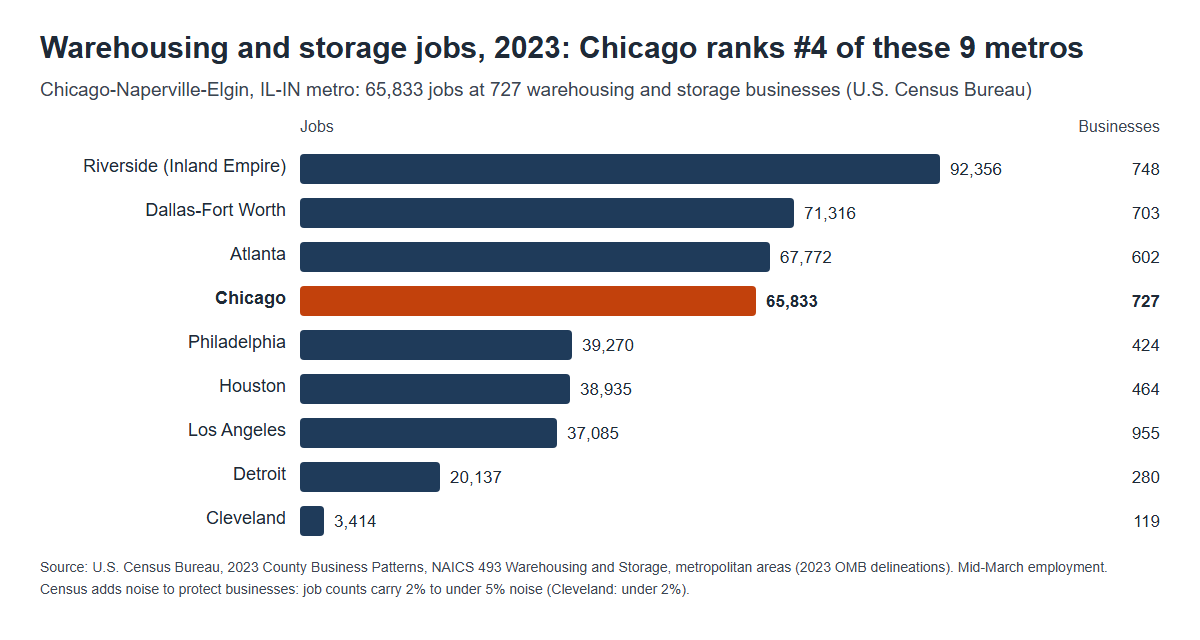
Chicago Industrial Zoning Districts, in Plain Words
The City of Chicago’s Manufacturing districts are M1, M2 and M3; its Planned Manufacturing Districts (PMDs) are a separate zoning classification. The City’s business zoning guide says the M districts are intended for manufacturing, warehousing and industrial uses outside the Central Area.
| District | What the City says it covers |
|---|---|
| M1 – Limited Manufacturing/Business Park | Low-impact manufacturing, warehousing and distribution activities that occur within enclosed buildings |
| M2 – Light Industry | Moderate-impact manufacturing, storage and industrial uses and activities that can occur outside |
| M3 – Heavy Industry | High-impact manufacturing and industrial uses, including extractive and waste-related uses |
| PMD – Planned Manufacturing District | Meant to foster the city’s industrial base; 14 districts in 26 industrial corridors (City count, February 2024) |
How to read it:
- Residential use is not permitted in the M districts, except for shelters, according to the City’s Bureau of Zoning.
- The City’s business zoning guide says specific business uses are allowed in specific zoning districts, either by right or only with special use approval.
- The Zoning Board of Appeals decides all special use, variation and appeal cases, with no City Council action.
- Look up a property’s district by address on the City’s Zoning and Land Use Map (chicago.gov/ZoningMap), run by the Department of Planning and Development.
From section 17-5-0207, the City’s use table for the manufacturing districts:
| Row in the use table | M1 | M2 | M3 |
|---|---|---|---|
| Outdoor Storage of Raw Materials as a Principal Use | Not allowed | Not allowed | By right |
| Contractor/Construction Storage Yard | Not allowed | By right | By right |
| RVs or Boat Storage | Not allowed | By right | By right |
| Container Storage | Not allowed | Special use | Special use |
| Freight Terminal | Not allowed | By right | By right |
| Vehicle Storage and Towing | By right | By right | By right |
| Parking, Non-Accessory | Special use | Special use | Special use |
The raw materials, container storage and freight terminal rows also cite use standard 17-9-0117. No row names truck or trailer parking or storage, and the table does not cover Planned Manufacturing Districts.
Sources: City of Chicago, Self-Certification Training Class: Bureau of Zoning Overview, slides dated 2/1/2024, on the Department of Buildings website; City of Chicago, Department of Business Affairs and Consumer Protection, Business Zoning Guide, last updated March 21, 2023; City of Chicago, Department of Planning and Development, Zoning and Land Use Map, online map (chicago.gov/ZoningMap); City of Chicago (Municipal Code, published by American Legal Publishing), Chicago Zoning Ordinance 17-5-0207 Use Table and Standards (Manufacturing Districts), export PDF of the section, pages marked Supp. No. 55, 64 and 66.
A summary, not legal advice: the Zoning Code itself governs.
Chicago Industrial Market: Q3 2026
From Cushman & Wakefield’s MarketBeat Chicago Industrial report for Q3 2026, which covers 20 industrial submarkets:
- Inventory: 1,312,855,070 sq ft of industrial space.
- Vacancy: 4.7% of industrial space was vacant, the fourth quarter in a row at that rate.
- Net absorption, year to date: 7,494,711 sq ft. More industrial space was filled than emptied in the first three quarters of 2026.
- Average asking rent (net, per sq ft per year): $7.53 overall; $7.20 for warehouse and distribution space and $7.55 for manufacturing space.
- Under construction: 14,781,036 sq ft.
These are one firm’s figures for one quarter.
Newer quarters and other reports may differ.
The Largest Chicago Industrial Submarkets
The six largest of the 20 submarkets by inventory in the same Q3 2026 report:
| Submarket | Inventory (sq ft) | Vacancy |
|---|---|---|
| Chicago South | 133,343,842 | 3.5% |
| Interstate 80 Corridor | 128,510,728 | 5.6% |
| Interstate 55 Corridor | 110,145,764 | 6.3% |
| Southern Fox Valley | 101,214,112 | 4.8% |
| Western Cook County | 100,838,425 | 3.7% |
| O’Hare | 97,613,102 | 3.5% |
The Interstate 80 Corridor led the market in new leasing through Q3 2026 with 9.0 million sq ft, followed by the Interstate 55 Corridor with 7.1 million sq ft.
Source: Cushman & Wakefield, MarketBeat Chicago Industrial, Q3 2026 (4-page PDF).
Rail and Air Cargo
- Rail: the CREATE Program, a partnership between the U.S. DOT, the State of Illinois, Cook County, the City of Chicago, Metra, Amtrak and the nation’s freight railroads, says nearly half of the nation’s intermodal trains pass through the Chicago region each year.
- Air cargo: Chicago O’Hare International’s all-cargo landed weight for 2025 was 8,482,484,822 lbs, 3.97% above 2024, which ranks it 6th nationally in the Federal Aviation Administration’s final table.
Sources: CREATE Program, Chicago Region Environmental and Transportation Efficiency Program (home page), web page; Federal Aviation Administration, Final Calendar Year 2025 All-Cargo Landed Weight, ORD row, table dated 9/22/2026.
How It Works
- Tell us about your property. Fill out the short form: the address, the property type, the size, and when you want to sell.
- We look at it. We review the details and look at the property.
- You get a cash offer.
- You decide. Say yes and we sign a purchase agreement. Say no and you owe nothing.
There is no commission to us and no fee to us. Asking for an offer is free, and you are not committed to anything unless you sign a purchase agreement.
Selling a Warehouse in Chicago: Frequently Asked Questions
Who buys warehouses directly from owners in Chicago?
Direct buyers such as Didenko Capital. We buy warehouses in all states, including Illinois and the Chicago area. Didenko Capital is run by Yarik Didenko.
Can a Chicago lot be used as an outdoor storage (IOS) yard?
It depends on the zoning district. Chicago’s use table for the manufacturing districts (section 17-5-0207) lists outdoor storage of raw materials as a principal use as permitted by right in M3 only, and a contractor or construction storage yard and RV or boat storage as permitted by right in M2 and M3 but not allowed in M1. Container storage, the table’s only container row, needs special use approval in M2 and M3 and is not allowed in M1. The table has no separate row for truck or trailer parking or storage; it lists vehicle storage and towing as permitted by right in M1, M2 and M3, non-accessory parking as needing special use approval in all three, and a freight terminal as permitted by right in M2 and M3 but not allowed in M1. The table also cites further use standards for some of these rows, such as section 17-9-0117 for a freight terminal, container storage and outdoor storage of raw materials. This table covers M1, M2 and M3 only, not Planned Manufacturing Districts (PMDs), which are a separate zoning classification. Ask your attorney before counting on a use.
How do I check my property’s zoning in Chicago?
Enter the address on the City’s Zoning and Land Use Map at chicago.gov/ZoningMap. The City’s business zoning guide says the district abbreviation shows on the map once you enter a specific address.
Do I need a Full Payment Certificate to sell in the City of Chicago?
Usually, yes. The City’s Department of Finance says a Full Payment Certificate shows that all utility charges and penalties on the account are paid in full or not transferable to the new owner, and that without one the parties cannot get the City of Chicago Real Property Transfer Tax stamps needed to record the deed with the Cook County Recorder of Deeds. The City says one is required in all transfers of real property unless law or rule provides otherwise, and lists a $50.00 application fee.
Are there property tax incentives for industrial buildings in Cook County?
Cook County’s Class 6b incentive covers property used for industrial purposes where the project involves new construction, substantial rehabilitation or the re-occupancy of abandoned property. According to Cook County, approved property is assessed at 10 percent for 10 years, 15 percent in the 11th year and 20 percent in the 12th year, against a standard assessment rate of 25 percent, and every incentive application needs the support and consent of the municipality. Ask your attorney what that means for your building.
What about environmental history on an older Chicago site?
Environmental history is part of how we price a property, not an automatic no. In Illinois, the Illinois EPA’s Site Remediation Program gives people who want to investigate or clean up a site the opportunity to receive review, technical assistance and no further remediation determinations. The Illinois EPA says a No Further Remediation (NFR) letter signifies a release from further responsibilities under the Illinois Environmental Protection Act. Ask an environmental attorney or consultant about your site.
Is it a cash offer?
Yes. We make cash offers.
Do you buy warehouses in Illinois?
Yes. We buy in all states.
Get a Cash Offer for Your Chicago Warehouse
We buy in all states, as-is, with a cash offer and no commission to us. Tell us about your warehouse and get a cash offer.
Related: Sell my warehouse · How to sell commercial property by owner · Sale-leaseback for warehouse owners · Sell Your Warehouse in Atlanta, GA · How much is my commercial property worth · Sell Your Warehouse in Cleveland, OH · Sell Your Warehouse in Detroit, MI · Sell Your Warehouse in Philadelphia, PA · Sell Your Warehouse in Dallas, TX
Sources
Facts on this page come from the public sources listed at the bottom, read on the dates shown.
- Cushman & Wakefield, MarketBeat Chicago Industrial, Q3 2026 (4-page PDF) (read 2026-10-11).
- City of Chicago, Self-Certification Training Class: Bureau of Zoning Overview, slides dated 2/1/2024, on the Department of Buildings website (read 2026-10-11).
- City of Chicago, Department of Business Affairs and Consumer Protection, Business Zoning Guide, last updated March 21, 2023 (read 2026-10-11).
- City of Chicago, Department of Planning and Development, Zoning and Land Use Map, online map (chicago.gov/ZoningMap) (read 2026-10-11).
- Cook County Government, Property tax incentives, web page (read 2026-10-11).
- City of Chicago, Department of Finance, Full Payment Certificates, web page (read 2026-10-11).
- Illinois Environmental Protection Agency, Site Remediation Program, web page (read 2026-10-11).
- CREATE Program, Chicago Region Environmental and Transportation Efficiency Program (home page), web page (read 2026-10-11).
- Federal Aviation Administration, Final Calendar Year 2025 All-Cargo Landed Weight, ORD row, table dated 9/22/2026 (read 2026-10-11).
- City of Chicago (Municipal Code, published by American Legal Publishing), Chicago Zoning Ordinance 17-5-0207 Use Table and Standards (Manufacturing Districts), export PDF of the section, pages marked Supp. No. 55, 64 and 66 (read 2026-10-21).